

Before we could speak with words, we spoke with movement. We instinctively had a way of reaching, responding, exploring, receiving, and finding our way into relationship.
Have you ever wondered why closeness sometimes feels uncomfortable or difficult? Or perhaps why you feel like one part of you desperately wants to cling to someone, while another part of you wants to pull away? Maybe you’ve sat next to someone you love and wondered if they are truly present—if they see you—hesitating to reach out for fear they won’t respond back. Why is it so challenging for some of us to reach, receive, or trust?
We often look for these answers in adult communication styles or childhood patterns, but I’d like to take us to a time much earlier and more primitive.
A few days ago, I dropped a glass bottle from the fridge, watching it shatter at my feet. I had been rushing, trying to squeeze in last-minute tasks before leaving the house. My hands were still wet, the bottle slipped, and I was left with a mess I didn't even have time to clean.
Immediately, I felt a familiar frustration, I called myself a spaz and berated my lack of focus. But as I sat with it, I realized this wasn't an isolated event. This whirlwind in my stomach, the feeling that I am perpetually running out of time and bracing for something to go wrong, has been with me for as long as I can remember.
In this blog post, we explore why we develop these hurried rhythms and how our earliest experiences specifically the first hour of life, shape our capacity to move through the world. By returning to the newborn’s innate choreography of movement, rest, and connection, we can begin to understand how to move at our own pace and find the safety to truly pause.
Underneath all that rushing is a feeling that I am perpetually running out of time and I’m going to get in trouble. I need to hurry up, get everything done, keep moving, because if I don’t something really bad is going to happen. I’ll have failed and disappointed someone.
There have been times where I prided myself on being efficient, productive, earning my keep in the world or I brush it off as being someone who can’t simply focus.
But really, where is this coming from? This whirlwind in my stomach spinning around frantically trying to get to the finish line but bouncing all over the place. Fail faster - I’m tired of failing!
My idea of slowing down is going for a walk, or writing, certainly not resting. And even when I am doing something I love, I race through it so fast, I don’t even take the time to enjoy it.
I think about my own birth being a theme of hurry up to survive, like I’m going to die. I was placed in an incubator at birth. I had some minor health issues being a bit premature. I don’t think I ever had a moment to really pause and integrate after birth. I wondered when did I first learn to organize myself around this?
I think we don’t even realize how much energy goes into maintaining a certain rhythm. We become the one who hurries, anticipates, manages, performs or tries to stay one step ahead of the shoe dropping and call it normal.
One thing about exploring these early birth imprints is that it brings up a lot of very tender spots inside of me. I ask myself to sit with them instead of running ahead of them. What would it feel like to have enough safety to pause? To move at my own pace? To trust that nothing terrible is going to happen if I take a breath?
This is one of the reasons I find the newborn’s first hour so fascinating. When a baby is making that transition into the outside world, there is a natural rhythm of movement and rest, reaching and responding, exploring and receiving.
I wonder how much of our ability to move through life easily and comfortably depends on whether we were met in those early moments and whether we can find new experiences of being met now.
Here, we’re going back to the very first hour of life.
In the first moment of life, there were many extraordinary things happening. A foundation for relationships was being laid. You weren’t just lying there waiting for someone to take care of you. You were born with natural primitive reflexes you followed.
Throughout much of history, we were taught to believe that a newborn baby was a blank slate, a helpless unaware being who needed to be taught how to relate to the outside world. With much of the research done in prenatal and perinatal psychology, we are learning how remarkably aware a newborn baby really is.
This article is about the amazing capacities a newborn baby has in the first hours of birth to organize and orient towards relationship and life through rhythm and movement and why this time is so critically important.
In my previous articles, we have moved from the time of implantation through the birth canal the beautiful orchestration between mother and baby. You can find them in my blog.
This time I am approaching this first moment at birth as a choreography and dividing the phases after birth into seven acts much like a play.
ACT I - Baby arrives already knowing something
A baby is born already looking, listening, smelling, moving, reaching, orienting and communicating. These qualities began prenatally while still in the womb. Babies recognize their mother’s voice and responds to her from the inside. The dance between mother and baby has already been happening.
Birth isn’t the beginning of the relationship, it’s the moment where the relationship changes environments.
The baby has experienced their mother’s movements, her sounds, her rhythm, and her chemistry, now the sound of her voice that came through water, tissue and bone is now on the outside. Imagine coming out and recognizing that voice and now there is a face that goes with it.
ACT II - Baby is aware - not a blank slate
- The baby can see
The visual range of a newborn is about 8-12 inches which is about the distance between a baby held at the breast and the mother’s face. One famous study in 1975 showed at a median age of nine minutes found babies could track a proper face like pattern over a scrambled version of one. At birth there is already an ability prepared to orient towards faces.
- The baby can hear and recognize
A baby isn’t coming into a completely unfamiliar world. There are clues such as voice, smell, and rhythm that is familiar. Babies have been shown to prefer the voice of their mother even over other female voices after birth. They will also recognize and show preference to their father’s voice and to other family members.
- The baby smells its way towards the breast
A baby can discriminate between their mother’s odors and even other lactating females. There are chemical cues between breast secretions and amniotic fluid which the baby recognizes and uses to orient towards the breast.
This brings us to the next Act of the breast crawl.
ACT III - The breast crawl - don’t help me yet
This is my favorite part. If a baby is placed directly on the mother’s stomach immediately after birth, the baby will find its way on its own towards the breast and begin suckling without any assistance whatsoever. This happens roughly between 60-90 minutes.
Babies progress through nine instinctive stages during the first hour when there is immediate, continuous and uninterrupted skin-to-skin contact with the mother.
- Birth cry is the transition to breathing, a distinct and specific cry when the lungs expand for the first time.
- Relaxation is a time immediately after the cry ends and becomes still with no visible movements.
- Awakening begins as the baby opens their eyes for the first time, blinks and has small movements of the mouth, head, face, shoulder and limbs.
- Activity involves larger body movements, including whole arm motions, lifting the head, stable open eyes and begins to explore.
- Rest can happen at any point during the first hour interspersed between the stages or transition between stages. Development requires rest and pauses which is part of all natural processes.
- Crawling involves the baby moving purposely towards the breast and nipple through motion such as sliding, bobbing, pushing and leaping. The legs push and the arms move.
- Familiarization is the stage at the mother’s nipple where the baby explores the breast with smells, touches, licks, tastes, and moves around the nipple. Exploration and relationship happen before feeding begins.
- Suckling involves the baby attaching to the nipple and initiating breast feeding.
- Sleeping is an involuntary activity which happens around 11/2 - 2 hours after birth, settles and falls asleep. Again there is more rest.
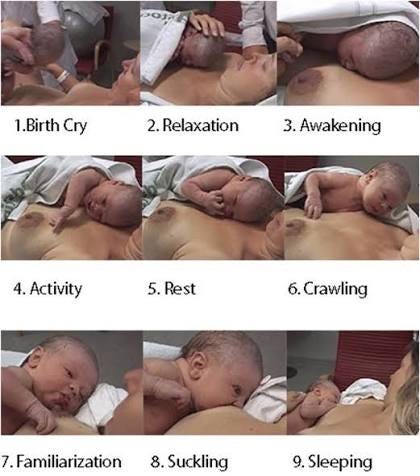
The stages are not rigid timetables. Marshall and Phyllis Klaus in their book “The Amazing Newborn”, say the average time is 55 minutes from birth to suckling. The baby isn’t just finding food, it is also finding its way into a new relationship.
There is an extraordinary repertoire of ways to interact with the environment.
The baby can:
Orient toward something familiar
Move toward nourishment
Show distress
Grasp
Explore
Pause and Rest
Respond to touch
Settle through contact
Recognize mom and dad
And the environment responds back.
The mother’s body provides warmth, scent, sound, touch and nourishment. Her movements and hormonal state are fluctuating too. The newborn sends out a signal which invokes a response from others nearby.
ACT IV - The hormonal dance
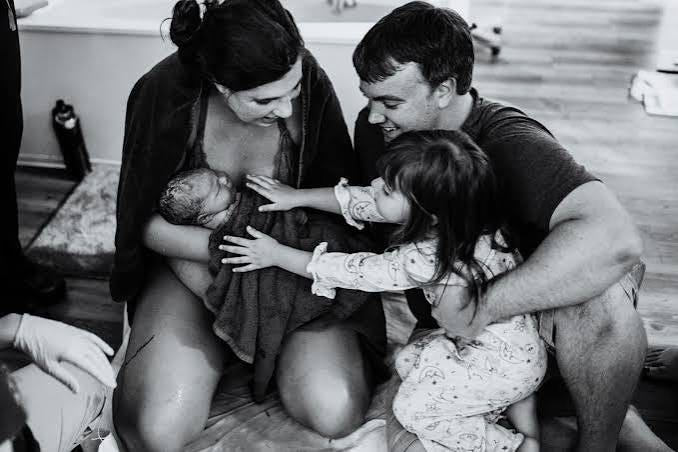
Here we have a hormonal cocktail between baby, mom and even father. They are all changing and responding to this relational choreography. Both mother and baby go through an enormous physiological change. The mother’s oxytocin rises alongside very high levels of catecholamines in the baby.
Even the father at birth experience changes in testosterone, prolactin, cortisol and oxytocin. In response to the infants cues, a father’s testosterone lowers and prolactin, and oxytocin rise which is associated with greater paternal responsiveness. The whole family system is reorganizing.
Even if the baby cannot receive skin-to-skin contact with mother immediately after birth, the father can still place the baby on his bare chest. These babies tend to cry significantly less than those placed in cots beside them.
ACT V - Primitive Reflexes
Primitive reflexes are automatic responses that develop before birth. They help secure feeding, protection orientation and movement as the nervous system is developing. Not every early reflex is part of the breast crawl and some reflexes will not be visible within the first hour. Some reflexes appear in a newborn exam, while others appear spontaneously.
As the baby continues to develop, many of these reflexes become inhibited or integrated into more complex patterns of movement.
I had a very interesting conversation on one of my podcasts with Emily Roper of Early Roots about these primitivereflexes in association with neurodevelopment delays, you can listen to it here:
Let’s go through the most important ones at birth.
- Rooting reflex - finding the breast. When the baby’s cheek or the corner of the mouth is touched, the baby will turn toward the stimulus, open the mouth and begin searching. This helps the baby find the nipple.
- Sucking reflex - receiving nourishment. When the mouth reaches the nipple, suckling happens automatically. The baby is able to suckle, swallow and breath all together.
- Stepping reflex - the beginning of locomotion. During the breast crawl, the baby uses repeated leg movements and foot pressure to push and slide toward the breast. There is a left-right motion that helps both sides of the brain’s hemispheres to coordinate. The mother also receives the benefit of her uterus being contracted from the pushing of the baby’s feet.
- Moro reflex - the startle response. A sudden change in position, a startling sound or sensation causes the baby’s arms and legs to extend outward and then draw back in. This is a protective response some babies can get stuck in.
- Palmar grasp - the instinct to hold. When the baby’s palm is touched, the fingers will close around the object touching it. During the breast crawl, hands also become involved in touching, exploring and moving between the breast and mouth.
- Asymmetric tonic neck reflex - the fencing posture. When the baby’s head turns to one side, the arm on the other side extends while the opposing arm bends. This is an automatic pattern involved in early motor organization.
- Other reflexes not part of the breast crawl include the plantar grasp, Babinski and placing reflexes are more part of neurological development.
None of these reflexes are random movements. They are part of the built in repertoire for responding to the outside world before the baby is able to develop control of their own movements.
ACT VI - The Golden Hour - Participating in attachment
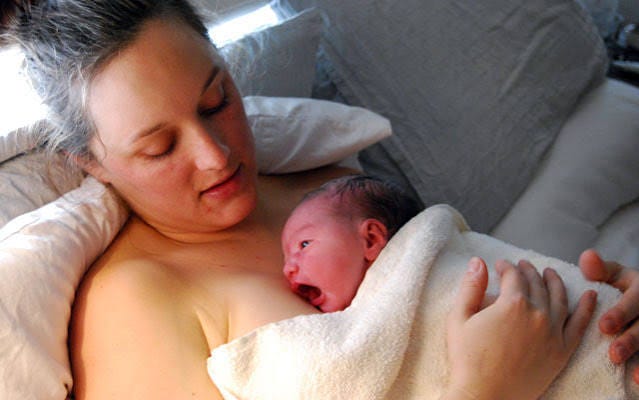
The first hour is an opportunity for bonding and attachment and it doesn’t have an expiration date. Even if you were premature, needed time in the NICU, was born via cesarean or mom needed assistance, you were adopted or there were medical emergencies, you can still repair, re-pattern and rewrite your birth for bonding and attachment.
Humans are far more flexible than animals who do not receive immediate bonding and attachment at birth. Early separation does not mean bonding cannot occur later.
ACT VII - Attachment today - how we relate now
What does this golden hour after birth have to do with me today? What happens when the natural dance of reaching and being met feels more like a foreign deserted wasteland?
Every baby comes into the world with natural impulses and they are all relational. Everything from orienting, reaching, pausing, looking, listening, smelling to moving toward, exploring, receiving and settling.
The baby is not asking how to become securely attached, it’s participating in the process of attachment. We all come into the world wired for connection and relationship before we are born. The natural impulses have always been inherently within us.
These instinctive impulses can become disrupted but not destroyed. We learned to adapt in ways that maintained connection and attachment.
When someone reaches toward you now, are you able to receive them?
When you need comfort, can you move toward someone?
Can you send a signal as a request?
Can you wait for a response?
Can you tell the difference between rest and abandonment?
Can you explore before committing?
Can you receive nourishment without having to earn or perform for it?
Can you settle into another person without loosing yourself?
Can you let yourself be met?
The condition beneath the pattern or imprint is a need still longing to be met. The nervous system learned that reaching out doesn’t always mean being met. There is a fear of resting into connection without constant checking.
THE MISSING EXPERIENCE
Whatever was missing in the early beginning can receive a new corrective emotional experience and your system can experience being met. Your body can learn what that experience feels like deep down inside at the very core of your being.
This might mean:
I reach and someone notices.
I pause and nobody leaves.
I don’t have to scream before someone hears me.
I move toward and you are still available.
I receive care without having to earn it.
I rest and connection stays present.
Let’s look at the nine stages of the first hour of birth again.
cry → relax → awaken → act → rest → move → explore → receive → sleep
Notice how the baby is participating with a responsive environment. There is movement and rest. There is agency and receiving. There is movement and relationship.
Yes, we know that a newborn can see a face, recognize a voice, smell their way forward to a breast and propel across the mother’s body but what is really amazing is how they are already prepared for relationship. A baby comes into the world in search for connection and is already able to interact with it. We are designed to develop within relationship.
It’s never too late to still experience being seen,
responded too,
held without being controlled,
move at your own pace,
reach and find someone there,
rest without losing connection.
Healing doesn’t mean you have grown out of needing anyone. It’s discovering that reaching and being met were part of our human design all along.
The newborn within us reveals what we were expecting from relationship before we learned to adapt.
We don’t have to become less dependent on relationship to become whole. We need experiences of relationship that allow us to become more fully ourselves.
If you’ve enjoyed my article and you are interested in learning more about your early core unmet needs be sure to take the Primal Needs Online Quiz.
Resources:
Your Amazing Newborn by Dr. Marshall H. Klaus, M.D., and Phyllis H. Klaus, C.S.W., M.F.C.C
PubMed1975 Oct;56(4):544-9. Visual following and pattern discrimination of face-like stimuli by newborn infants C C Goren, M Sarty, P Y Wu PMID: 1165958
https://babyschool.yale.edu/does-my-baby-recognize-me/
Matern Child Nutr. 2017 Dec 12;14(2):e12571.
Birth 2007 Jun;34(2):105-14. Skin-to-skin care with the father after cesarean birth and its effect on newborn crying and prefeeding behavior
Ciba Found Symp 1975:(33):87-101.Evidence for a sensitive period in the human mother
Barrera, M. E., & Maurer, D. (1981). Recognition of mother’s photographed face by the three-month old infant, Society for Research in Child Development, 52(2), 714-716.
Cernoch, J. M. & Porter, R. H. (1985). Recognition of maternal axillary odors by infants. Child Development, 56(6), 1593-1598.
DeCasper A. J., & Spence M. J., (1986). Prenatal maternal speech influences newborns’ perception of speech sounds. Infant Behavior and Development, 9, 133-150.
Field T. M., et al. (1984). Mother-stranger face discrimination by the newborn. Infant Behavior and Development, 7, 19-25.
Mills M., & Melhuish E. (1974). Recognition of mother’s voice in early infancy. Nature, 252, 123-124.


0 Comments